

Networking Basics
The Speed of Business: Navigating Fibre vs. Copper in the Multi-Gig Era
Sep
Published by Connectivity Warehouse | Network Infrastructure Series
The foundation of any modern business is its network. Digital transformation, cloud-first strategies, and high-bandwidth applications now define the era — 4K video streaming, AV over IP, IoT device management, and unified communications. Consequently, the speed and reliability of your network infrastructure are no longer just IT considerations. They are core business imperatives. Every second of latency, every bottleneck in a switch, and every metre of degraded cabling represents lost productivity, frustrated users, and missed opportunity.
As organisations evaluate and upgrade their connectivity, one debate remains central: fibre optic versus copper cabling. Understanding the speed advantages, technical limitations, and ideal use cases for each technology is essential. Moreover, with the introduction of multi-gigabit hardware, the conversation has become considerably more nuanced and, frankly, more exciting.
How the Two Technologies Work
Before comparing performance, it helps to understand what is happening inside the cable. Copper Ethernet cables transmit data using electrical pulses. These are the familiar Cat5e, Cat6, and Cat6a cables found in virtually every office, school, and data centre. Fibre optic cables, by contrast, use pulses of light (photons). These travel through ultra-thin strands of glass, each no wider than a human hair.
This fundamental difference in transmission medium is the root cause of every performance gap between the two technologies. Light travels faster than electrical signals, it does not generate electromagnetic interference, and it degrades far less over distance. The physics are, quite simply, in fibre’s favour.
The Speed and Bandwidth Advantage
In advanced deployments, fibre optic cables support data transmission speeds of up to 60 Terabits per second (Tbps). That figure dwarfs copper’s practical ceiling of approximately 10 Gigabits per second (Gbps) under optimal conditions. For most enterprise and SMB environments, the relevant comparison is more grounded, but the gap remains significant.
Equally important is the concept of signal attenuation, or how much a signal degrades over distance. A copper cable experiences up to 94% signal loss over distances exceeding 100 metres. A fibre optic cable, however, loses only around 3% over the same distance. Certain fibre types can carry a signal reliably for up to 25 miles without active amplification. For copper, the 100-metre rule is a hard engineering constraint, not a guideline.
Fibre also offers a meaningful advantage in latency. Light travels faster than electrical pulses, and fibre connections require fewer active amplification devices between endpoints. Therefore, fibre delivers lower latency — a critical factor for real-time applications like voice-over-IP, video conferencing, and live broadcast production.
The Limitations of Each Technology
Understanding where each technology falls short is just as important as celebrating where it excels.
| Factor | Fibre Optic | Copper (Cat5e / Cat6 / Cat6a) |
| Maximum Speed | Up to 60 Tbps | Up to 10 Gbps (Cat6a) |
| Maximum Distance | Up to 25 miles (single-mode) | 100 metres |
| Signal Loss at 100m | ~3% | ~94% |
| EMI Susceptibility (Electro Magnetic Interference) | Immune | Susceptible |
| Security Risk | Very low (cannot be tapped electronically) | Higher (susceptible to signal interception) |
| Installation Cost | R8–R12 per foot (higher) | R1–R6 per foot (lower) |
| Durability | Withstands ~200 lbs of pressure | Withstands ~25 lbs of tension |
| Power over Cable (PoE) | Not supported | Fully supported |
Table 1: A comparative overview of fibre optic and copper cabling characteristics.
Fibre’s primary limitations are cost and complexity. Installing fibre for the first time costs significantly more than copper. The cable itself is pricier, and so are the specialist termination equipment and skills required. Fibre also cannot carry electrical power, so it cannot support Power over Ethernet (PoE). PoE allows a single cable to deliver both data and power to devices like access points, IP cameras, and VoIP phones.
Copper’s primary limitations are distance and interference. The 100-metre distance ceiling is a hard constraint in large buildings or campus environments. Copper cables are also susceptible to electromagnetic interference (EMI) from power lines, industrial equipment, and even other cables. That is a significant concern in environments like broadcast studios, factories, or data centres. Furthermore, eavesdroppers can theoretically intercept copper signals, a security consideration in high-sensitivity environments.
Where Each Technology Belongs
Given these characteristics, the choice between fibre and copper is rarely absolute. Instead, it is contextual.
Fibre is the preferred choice for:
Backbone and inter-building connections, where long distances make copper impractical. Data centre interconnects, where high throughput and low latency are non-negotiable. Environments with significant EMI, such as manufacturing floors, broadcast facilities, and industrial sites. High-security deployments where signal interception is a concern. New building developments where future-proofing justifies the upfront investment.
Copper remains the right choice for:
Last-mile endpoint connections within buildings, where distances are well within the 100-metre limit. Environments where PoE is required to power access points, cameras, or phones. Existing infrastructure where a full rip-and-replace is cost-prohibitive. SMB environments where the combination of affordability and adequate performance makes copper the pragmatic option.
In practice, most enterprise and medium-sized business networks use both technologies in a complementary architecture. Fibre forms the high-speed backbone between floors, buildings, and core switches. Copper then handles the horizontal runs connecting individual devices and workstations to the network.
The Multi-Gig Revolution: Getting More from Copper
Here is where the story takes a particularly compelling turn. For years, the standard for wired Ethernet connectivity was 1 Gigabit per second (1 Gbps). Then bandwidth demands grew, driven by WiFi 6 access points, 4K video production, NAS storage, and cloud applications. The 1 Gbps ceiling became a genuine bottleneck. The logical upgrade path was 10 Gbps. However, this required not only new switches and network cards but also an upgrade to Cat6a cabling or fibre. For most SMBs, the cost of replacing all their existing Cat5e or Cat6 cabling was simply not justifiable.
Engineers developed Multi-Gigabit Ethernet (NBASE-T) specifically to solve this problem. Standardised as IEEE 802.3bz, Multi-Gig technology delivers 2.5 Gbps and 5 Gbps over existing Cat5e and Cat6 cabling at the full 100-metre distance. Organisations simply upgrade their switches and connected devices. No cable replacement required.
This is a transformative development for several reasons. First, it unlocks the full potential of modern hardware already capable of 2.5G or 5G speeds. That includes WiFi 6 and WiFi 7 access points, high-performance NAS devices, and workstations with multi-gig network cards. Previously, legacy switching infrastructure throttled all of them to 1 Gbps. Second, it provides a cost-effective, minimally disruptive upgrade path that protects existing cabling investments while significantly increasing network capacity.
Multi-Gig switches also feature intelligent auto-negotiation. They automatically detect the maximum speed supported by each connected device and cable, then operate at that speed. A device capable of 2.5G will connect at 2.5G. A legacy device capable only of 1G will connect at 1G — all from the same switch, with no manual configuration required.
Network Infrastructure: The Foundation of the Digital Ecosystem
It is worth pausing to consider where network infrastructure fits in the broader technology ecosystem. Every application, every cloud service, every wireless device, and every digital workflow ultimately depends on the physical and logical network beneath it. The network is not a commodity; rather, it is the foundation that supports every other technology investment.
A WiFi 6 access point delivering multi-gig wireless speeds is only as effective as the switch port it is connected to. A NAS device capable of 10G throughput is throttled by a 1G switch. A cloud-based collaboration platform is only as responsive as the WAN connection and the LAN infrastructure supporting it. In this context, investing in the right network infrastructure is not an IT expense; it is a business enabler.
This is precisely why the Total Network Solution concept has become so important. It is an integrated, end-to-end approach to network design. Rather than assembling disparate components from multiple vendors and hoping they interoperate, a cohesive solution aligns every layer of the network. The router, the switch, and the access point all work together seamlessly.
Netgear’s Total Network Solution: Purpose-Built for the Multi-Gig Era
Netgear has built its business-grade product portfolio around exactly this philosophy. The Netgear Total Network Solution integrates the PR60X Pro Router, Insight Managed Multi-Gig Switches, and Pro WiFi Access Points into a unified ecosystem. The Netgear Insight cloud platform manages it all — a single pane of glass for deploying, monitoring, and managing the network from anywhere.
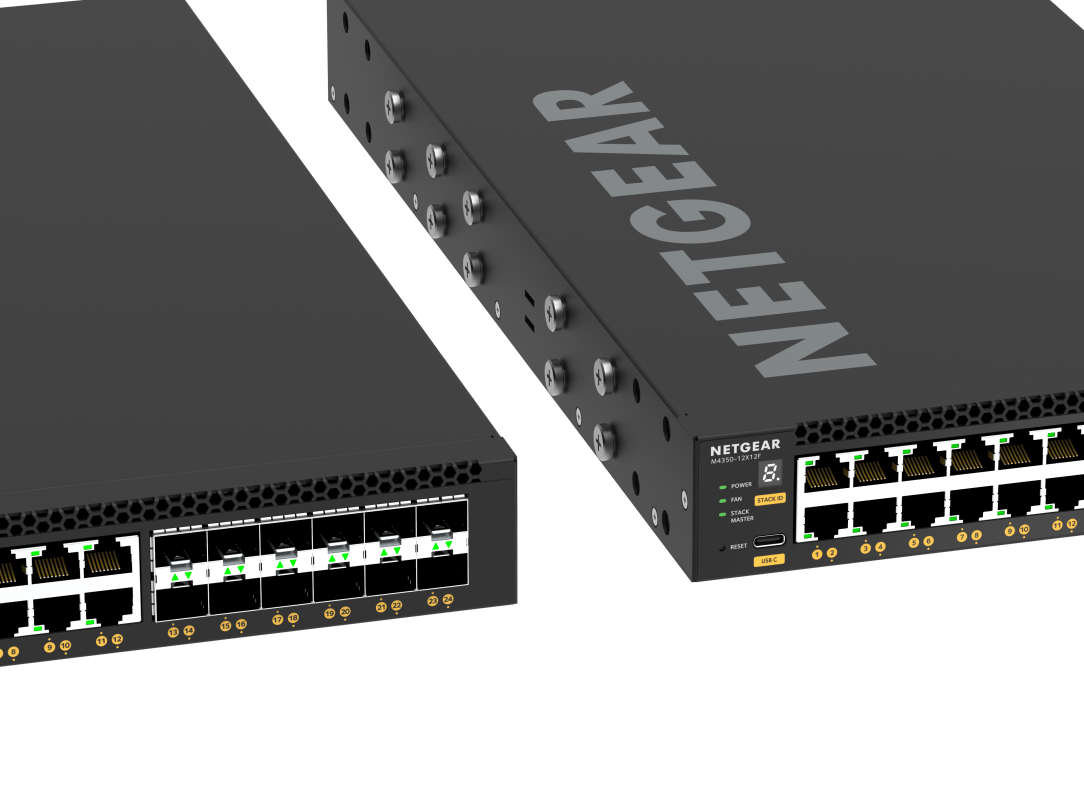
At the heart of this solution are Netgear’s Multi-Gig switches, including the M4250 AV Line and M4350 series. They are engineered for both enterprise IT and professional AV environments. These switches support the full spectrum of speeds from a single device: 100 Mbps, 1 Gbps, 2.5 Gbps, 5 Gbps, and 10 Gbps. They also include SFP+ fibre uplink ports for high-speed backbone connections. They feature PoE++ (802.3bt) support as well, delivering up to 90W per port over copper. That is enough to power the most demanding access points, PTZ cameras, and AV-over-IP endpoints.
This combination is particularly powerful in corporate campuses, broadcast facilities, live event venues, and educational institutions. In these environments, the network must simultaneously support high-density wireless, surveillance, IP telephony, and high-bandwidth media workflows. Fibre handles the backbone; copper handles the endpoints; Multi-Gig switches bridge the two, and NETGEAR’s Insight platform ties it all together.
Practical Guidance: Choosing the Right Architecture
When planning or upgrading a network, the following framework provides a useful starting point:
| Scenario | Recommended Approach |
| New building or greenfield deployment | Install fibre backbone; use Cat6a copper for endpoints with Multi-Gig switches |
| Existing Cat5e/Cat6 infrastructure, growing bandwidth needs | Upgrade switches to Multi-Gig (NBASE-T); achieve 2.5–5 Gbps without recabling |
| Long-distance inter-building connections | Fibre only; copper is not viable beyond 100 metres |
| High-density wireless (WiFi 6/7 access points) | Multi-Gig copper uplinks to access points; fibre backbone to core switch |
| Broadcast or AV-over-IP production environments | Multi-Gig switches with fibre uplinks; Netgear M4350 series recommended |
| PoE-dependent devices (cameras, phones, APs) | Copper with PoE++ switches; fibre cannot carry power |
Table 2: Recommended network architecture by deployment scenario.
The Bottom Line
The fibre versus copper debate does not have a single winner; it has a context. Fibre is unmatched for speed, distance, and future-proofing. Copper is indispensable for endpoint connectivity, PoE delivery, and cost-effective deployment in existing buildings. And Multi-Gig technology is the bridge between them. It lets organisations extract significantly more performance from the copper they already have, without the disruption and expense of a full replacement.
The key insight is this: the right network is not the most expensive one. It is the one designed correctly for your specific environment, applications, and growth trajectory. That requires expertise, the right hardware, and a partner who understands both the technology and your business.
Ready to Upgrade? Connectivity Warehouse Has You Covered.
At Connectivity Warehouse, we specialise in delivering dependable networking, cabling, and connectivity solutions for businesses that demand performance and reliability. You may be designing a new network from scratch, upgrading existing copper with Multi-Gig switching, or deploying a full Netgear Total Network Solution. In every case, our team has the expertise to guide you from design through to deployment.
We are your trusted source for Netgear’s full range of Multi-Gig switches, routers, and access points – including the M4250 and M4350 AV Line switches, the PR60X Pro Router, and the complete Insight Managed ecosystem.
Do not let your network be the bottleneck that holds your business back. Contact Connectivity Warehouse today to discuss your Multi-Gig requirements or request a network assessment. We will gladly show you how the right infrastructure can transform the way your business operates.
Your network is the foundation. Build it right.
Get in touch with Connectivity Warehouse and let us help you move faster.
References
[1] Acceldata, “Role of IT Infrastructure in Digital Transformation,” Jan 30, 2025. Available:
[3] Netgear, “Go faster with 2.5 Gigabit and Multi Gig Ethernet.” Available:
[4] Netgear, “The Total Network Solution by NETGEAR Business.” Available: